
Meaning of El Shaddai: Discover God’s Powerful Name & Song
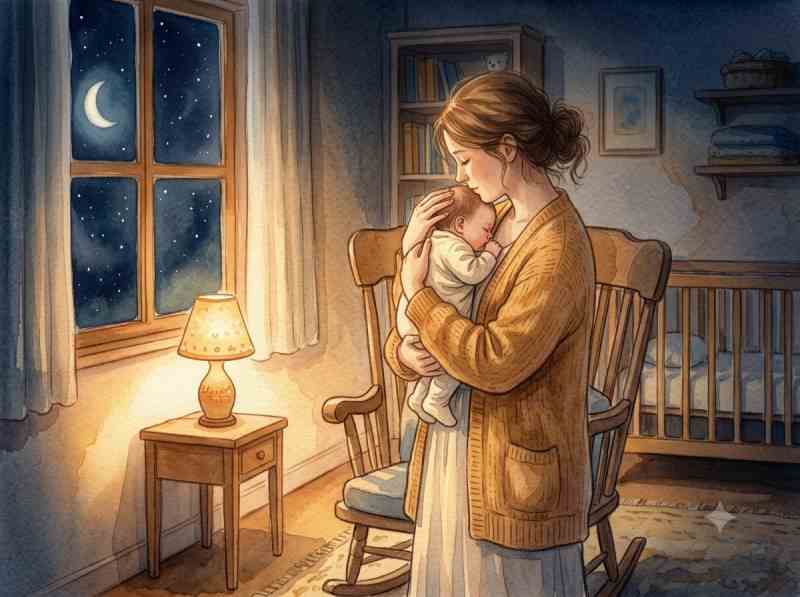
The meaning of El Shaddai is easiest to understand at 2 a.m., in a dark house, with a baby crying. Her mother stumbles out of bed, still half asleep, and scoops her up. The baby doesn’t need a speech or an explanation. She needs warmth, a heartbeat, and the quiet certainty that someone is here. Within a minute, the sobs slow. The tiny fists loosen. The whole room exhales.
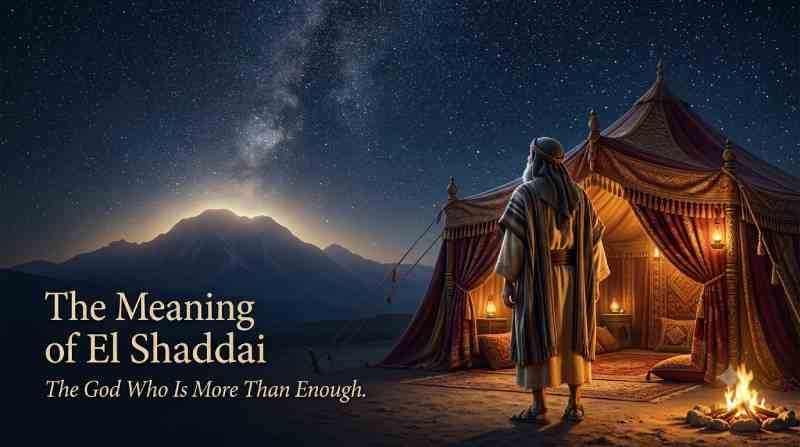
Hold that picture, because now we’re going to a very different night, thousands of years ago. An old man sits outside his tent under a star-filled sky. He is ninety-nine years old, with decades of waiting behind him and a promise that still hasn’t come true. His name is Abram, and he is tired in the way only long waiting can make you tired. Then God appears and introduces himself with a name no one has ever heard: El Shaddai.
Table of Contents
Why Did God Choose This Name? Unpacking the Meaning of El Shaddai
Here’s the question that haunts me about this scene: out of every name God could have used, why this one, for a man who had run out of strength and answers?
The meaning of El Shaddai (pronounced el shad-DYE) is Lord God Almighty, or the All-Sufficient One. El is simply the Hebrew word for God. Shaddai is where it gets rich. Its most common sense is “mighty” or “overpowerer,” the One whose strength nothing can stand against.
But here’s where it gets tender. Many scholars connect Shaddai with the Hebrew word shad, meaning “breast.” That gives the name a startling picture: a God who nourishes, satisfies, and supplies his people the way a mother cares for her child. He gives freely, he sustains, and he guards the interests of those he loves.
Others trace the name to an Akkadian word, šadu, meaning “mountain,” which points to strength that never moves. Scholars still debate the origin, and I find it lovely that the name may hold both pictures at once: a mountain you can’t shake, and arms that hold you close.
God reveals his character, power, holiness, and authority through his many names. That’s why we shouldn’t take the Lord’s name in vain. His names aren’t casual words. They’re invitations to fear, respect, and honor the One who carries them.
Meeting El Shaddai on the Page
The name El Shaddai appears seven times in the Old Testament, and the first time is Genesis 17:1. God says to Abram, “I am God Almighty; walk before me faithfully and be blameless.”
This is the first moment the meaning of El Shaddai is revealed in Scripture, and notice the order. Before God gives Abram a single command, he tells him who he is. It’s as if he’s saying, I know you’re worn out, so before I ask anything of you, remember who is asking. The call to walk faithfully rests on the promise that he is enough.
Does that change how you read the command? It changes how I do. Obedience stops feeling like a weight I carry alone and starts feeling like a walk beside someone who carries me.
The meaning of El Shaddai doesn’t stay in Genesis. It echoes through the Psalms, where the psalmist captures the same comfort: “Whoever dwells in the shelter of the Most High will rest in the shadow of the Almighty” (Psalm 91:1). The word translated “Almighty” there is Shaddai. Shelter and shadow, a mountain and a mother’s arms: all of it fits inside one name.
El Shaddai Song
The Lyrics
[Chorus:]
El Shaddai, El Shaddai [means “God Almighty, God Almighty”]
El Elyon na Adonai [means “God in the highest, Oh, Lord”]
Age to age, You’re still the same
By the power of the name
El Shaddai, El Shaddai
Erkamka na Adonai [means “We will love You, Oh, Lord”]
We will praise and lift You high
El Shaddai
Through Your love
And through the ram
You saved the son
Of Abraham
Through the power
Of Your hand
Turned the sea
Into dry land
To the outcast
On her knees
You were the God
Who really sees
And by Your might
You set Your children free
[Chorus]
Through the years
You made it clear
That the time of Christ
Was near
Though the people
Couldn’t see
What Messiah ought to be
Though Your Word
Contained the plan
They just could not understand
Your most awesome work was done
Through the frailty of Your son
The El Shaddai Song: A Worship Song That Sings the Story of Scripture
There’s a reason “El Shaddai” has moved so many hearts since Amy Grant first sang it in 1982. Written by Michael Card and John Thompson, it feels less like a performance and more like someone gently walking you through the Bible, one memory at a time. You’ll hear about the ram God provided on the mountain when Abraham needed a miracle. You’ll hear about a sea that opened when there was nowhere left to run. And you’ll hear about Hagar, alone and overlooked, who discovered God saw her.
Then the song lifts your eyes toward Jesus, where the story had been heading all along. Through the years, God made it clear that Christ was coming, yet when He arrived, many people missed Him. They were waiting for a mighty king, and they couldn’t quite imagine what the Messiah would really be like. The plan had been in Scripture the whole time, but it was hard to recognize in a humble, vulnerable child, and later in a Savior who would go to the cross.
That’s the quiet wonder the song leaves you with: God’s most awesome work was done through the frailty of His Son, where His strength looked a lot like gentleness.. Every verse carries the meaning of El Shaddai: a God strong enough to move mountains and tender enough to notice one tired heart. Press play tonight, close your eyes, and let it remind you that you are not carrying this alone.
What the Meaning of El Shaddai Looks Like This Week
Letting the meaning of El Shaddai sink in starts with one small, honest step. Try one of these:
- Name your “not enough.” Write down one area where you feel stretched thin, whether it’s money, energy, or patience. Then say out loud, “El Shaddai, you are enough here.”
- Pray the name slowly. Spend two quiet minutes breathing in “El” and breathing out “Shaddai.” Let it be a prayer with no other words.
- Read Psalm 91 slowly, and underline every picture of safety you find.
- Let music carry you. An El Shaddai song is a beautiful worship song that can bring your heart into the presence of the Heavenly Father. Play one on your commute or while you do the dishes.
A Closing Prayer
El Shaddai, God Almighty, you are the mountain I can lean on and the arms that hold me close. Where I’m tired, be my strength. Where I’m empty, be my enough. Teach me to honor your name, and let me live the meaning of El Shaddai today. Amen.
The Meaning of El Shaddai: Behind the Song
“El Shaddai” was written by Michael Card and John Thompson, and it’s a gentle, worshipful song shaped by Scripture. It first appeared on the 1981 album Legacy, long before it became a favorite in so many hearts and churches.
So what is the meaning of El Shaddai? It’s one of the best-loved names for God, often understood as “God Almighty,” and it carries a beautiful promise. The meaning of El Shaddai reminds us that the Lord sustains and blesses His people, and that He keeps every promise He makes. He is our mighty Creator, and there is no one else like Him.
We hope this song and the meaning of El Shaddai left your heart a little lighter today. Which line of the song speaks to you most? We’d love to hear it in the comments.
Our collection of inspirational contemporary Christian songs will rejuvenate your soul, bring Biblical truth to your life, and make your heart overflow in Godly passion.
Could you please explain what ram means in this context?
Thank you 🥰
Hi Lucia,
The ram is the one that Abraham sacrificed in place of Isaac.
Abraham looked up and there in a thicket he saw a ram caught by its horns. He went over and took the ram and sacrificed it as a burnt offering instead of his son. Genesis 22:13
In Depth Interpretation
Furthermore, the ram relates to Jesus Christ, who was sent into the world by the Almighty God to take our place and suffer for our transgressions. Despite the fact that He was sinless, He took on Himself the trespasses of the world and suffered and died on the cross for us in order to save us from eternal death and give us everlasting life.
1 Peter 3:18 Because Christ once went through pain for sins, the upright one taking the place of sinners, so that through him we might come back to God; being put to death in the flesh, but given life in the Spirit;
We hope we have clarified your doubt. 🙂
Regards,
Team Bibilium
Thank you! I appreciate the extensive answer!
You are most welcome.
Regards,
Team Bibilium
Hi
I would like to say that I have been trying to learn to sing the song. I much like it, it is profound.
Tried to compose better lyrics for this part “To the outcast on her knees” but no inspiration so far.
Those are wonderful lyrics, referring to Genesis 16, especially 16:13, where Hagar runs away from Sarai into the desert and God speaks to her. Also, Gen 21:14-19.
I am going to explain the usage and duality of meaning of Shaddai when we sing it for the first time at Church on Sunday. My Pastor would rather I invest time into the newer music but the congregation really appreciates the deep theological richness of the traditional standards so I try to cleverly sneak them into the meal plan for any given Sunday.
As a professional musician for over 30 years strong, I know you always have to play to the room, but as a worship leader also know the difference between a congregation and a concert! -TF
Hi Tracy,
Great to know about you. God bless you in your ministry. Hope you found the information useful.
Regards,
Team Bibilium
I love your attitude. To be a worship leader who draws others into being worshippers is to be sought after.
God bless you and your ministry.
The Hebrew connection to this name is fascinating. My experience with similar theological terms showed a different nuance.