
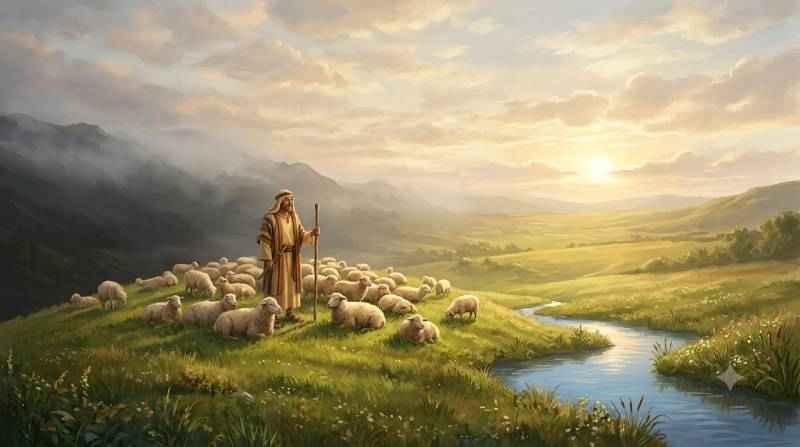
Psalm 23 Meaning: 6 Hidden Truths That Bring Real Comfort
Most of us carry a half-remembered line from childhood, but the real Psalm 23 meaning runs far deeper than we think. To see why, let’s start with a story.

At 2 a.m., a hospital corridor has its own sound. The fluorescent lights hum. A cart rattles somewhere far off. A monitor beeps behind a door, steady, then not quite steady, then steady again, and you realize you’ve been holding your breath for each beat.
Armand has been in the same plastic chair for six hours. The tea in his paper cup went cold around midnight. Inside the room, his mother sleeps under a tangle of wires, her hand looking smaller than he remembers.
He hasn’t prayed in years. He wouldn’t know how to start. But somewhere between the third beep and the fourth, a sentence floats up from a place he’d forgotten he kept. It’s his grandmother’s voice, cracked and certain, over a dinner table decades ago:
The Lord is my shepherd…
That’s all he gets. The rest is fog. He sits there with half a line, and for the first time all night, his shoulders drop an inch.
Table of Contents
The Turn: Why the Psalm 23 Meaning Still Comforts Us
Why that line? Of all the words in the Bible, why does Psalm 23 follow us into hospital corridors, graveside services, and the heads of people who haven’t opened a Bible since childhood? So what is the Psalm 23 meaning behind those few words?
I think it’s because this psalm does something almost nothing else does. It doesn’t explain suffering, and it doesn’t argue with it. In six short verses, it says one thing over and over: you’re not alone in this. It feels less like a doctrine and more like a hand on your shoulder.
But let’s not stop at the comfort. The Psalm 23 meaning is stranger, sharper, and more surprising than the version on the wall plaque. So let’s walk it slowly, the way you’d hike a trail you’ve driven past a hundred times.
Verse 1: “The Lord Is My Shepherd; I Shall Not Want”
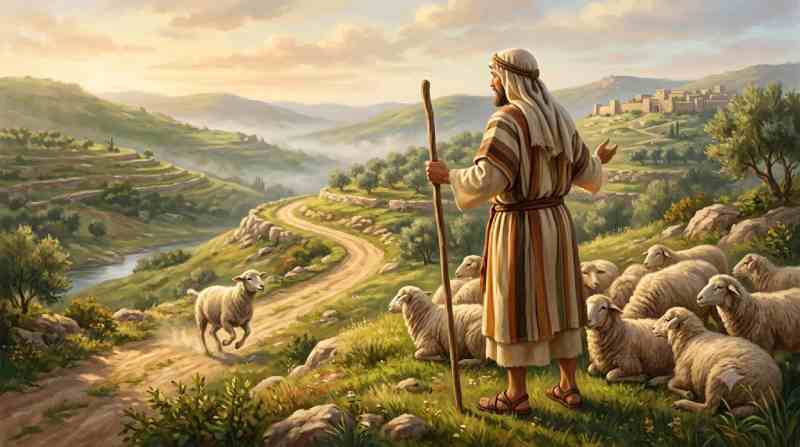
The Psalm 23 meaning starts with a surprising choice of words. David, the author, was a shepherd himself before he was a king. He isn’t reaching for a cute metaphor. He’s choosing the most humbling one available.
Sheep, as any shepherd will tell you, are not impressive animals. They wander off. They panic at shadows. They’ll graze one patch down to bare dirt and then starve beside it, never thinking to move. They can’t find water on their own.
So when David, the giant-slayer, the poet-warrior, the man who would wear a crown, writes “the Lord is my shepherd,” he’s also confessing: I am not as self-sufficient as I look.
And notice that small word, my. Not “a” shepherd, not “the” shepherd. My. It’s the way a child says “my mom” in a crowded room. Possessive. Unembarrassed.
“I shall not want” doesn’t mean you’ll never desire anything. It means that when the shepherd is yours, you won’t lack anything you truly need. There’s a difference between having everything you want and lacking nothing you need, and most of us spend years learning it. That is the first layer of the Psalm 23 meaning: needing a shepherd isn’t weakness; it’s wisdom.
Verse 2: “He Makes Me Lie Down in Green Pastures”

Why does the psalm say he makes me lie down? It sounds almost forceful.
Here’s the surprising part. Shepherds say a sheep will not lie down unless it feels completely safe: no fear of predators, no tension in the flock, no pests buzzing at its face, no hunger gnawing. A frightened sheep stays on its feet, even when it’s exhausted.
So “he makes me lie down” isn’t bossiness. It’s the shepherd quietly clearing away every reason the sheep had to stay braced.
Read that against your own life. When was the last time you rested because you felt safe, not because you crashed, or finished, or finally earned it? For most of us, rest is a prize at the end of exhaustion. This verse imagines rest as the natural response to being cared for.
The “still waters” matter too. Sheep are terrified of rushing streams. The shepherd doesn’t lead them to the dramatic river. He finds the quiet pool where they can actually drink. The Psalm 23 meaning here is simple and generous: rest is what happens when you finally feel safe.
Verse 3: “He Restores My Soul”

Shepherds have a word for a sheep that rolls onto its back and can’t flip over: cast. A cast sheep is helpless. Its legs kick at nothing, and if no one comes, it can die within hours.
What does the good shepherd do? He doesn’t lecture it about balance. He finds it, rolls it upright, and holds it steady until its legs remember how to work.
He restores my soul. Maybe that’s the picture: not a shepherd who scolds you for being stuck, but one who goes looking and stays until you can stand. The “paths of righteousness” that follow are simply the right paths, the ones that actually lead somewhere good. And notice that he leads me along them. I’m not asked to find the way alone. In the Psalm 23 meaning, restoration looks like a rescue, not a reprimand.
Verse 4: “Even Though I Walk Through the Valley of the Shadow of Death”
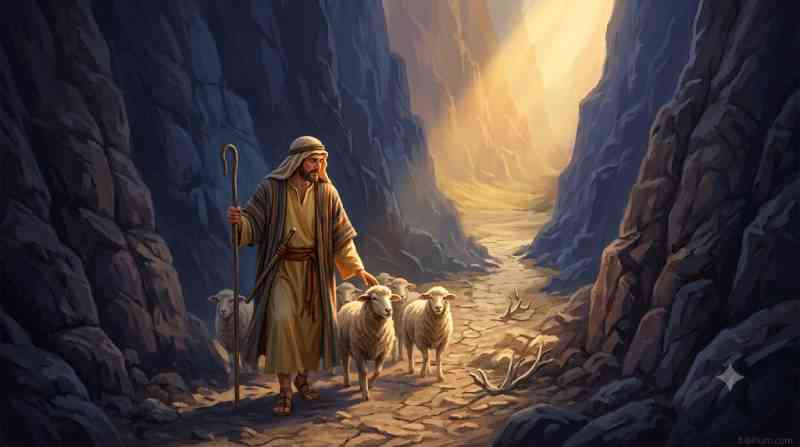
Nowhere is the Psalm 23 meaning tested more than in this verse, the one everyone knows, and the place where the poem quietly changes its voice.
For three verses, David talks about God: “He makes… he leads… he restores.” Then, right at the darkest point, the pronoun flips: “You are with me.”
Did you catch that? In the valley, he stops describing God and starts talking to him. It’s as if the shadow makes the conversation more direct.
And look at what he doesn’t say. He doesn’t say he’ll avoid the valley, or be airlifted over it. He walks through it. The valley is real. The shadow is real. But it’s a place you pass through, not a place you’re asked to live.
“Your rod and your staff, they comfort me.” The rod fought off wolves. The staff hooked a sheep’s neck to pull it back from a cliff edge. Protection and tenderness, from the same hand. The comfort isn’t that danger is gone. It’s that the one beside you knows exactly what to do with it. That is the heart of the Psalm 23 meaning for our hardest seasons.
Verse 5: “You Prepare a Table Before Me in the Presence of My Enemies”

The Psalm 23 meaning takes its boldest turn here, and it’s one of the most daring images in the Bible. Suddenly there’s a banquet: a table, a meal, oil poured on the guest’s head, a cup so full it spills over the rim.
And the enemies? They haven’t left. They’re standing right there, watching.
Peace doesn’t always arrive after the conflict ends. Sometimes it arrives in the middle of it, a calm meal in a hostile room, a stillness that makes no sense to the people glaring at you from the doorway.
Some of us have lived this. The diagnosis is still real, the lawsuit is still pending, the family is still fractured, and somehow, on an ordinary Tuesday, there’s a quiet that doesn’t add up. This verse says that quiet isn’t imaginary. It’s a table. And that is the Psalm 23 meaning at its most courageous.
Verse 6: “Surely Goodness and Mercy Shall Follow Me”

The final layer of the Psalm 23 meaning is about pursuit. The Hebrew word behind “follow” is much stronger than it sounds in English. It means pursue. Even chase.
Goodness and mercy aren’t strolling politely behind you. They’re running after you, and you’ve been so busy chasing security, approval, and a settled life that you haven’t noticed them gaining ground.
Look at where the psalm ends. It began in an open field with a wandering sheep. It ends in a house, with a guest who stays. By the last line, the sheep and the guest are the same person, and the shepherd is simply home. That’s the whole Psalm 23 meaning in miniature: you were never wandering without someone looking for you.
Why the Psalm 23 Meaning Still Matters Today
The Psalm 23 meaning has traveled far from David’s hillside. It’s read at weddings, recited at funerals, and whispered in hospital corridors, because the Psalm 23 meaning speaks to the one fear we all share: being left alone. Three thousand years later, we still need a shepherd. We still get stuck, we still walk through valleys, and we still long for a table and a home.
Living the Psalm 23 Meaning This Week
You don’t need to master the psalm to live the Psalm 23 meaning. You just need to live inside a line or two of it. Here are a few small ways:
- Rest before you’ve earned it. Once this week, take ten unproductive minutes. No phone, no podcast. Tell yourself: I’m allowed to stop because I’m cared for, not because I’ve finished.
- Switch your pronouns. If you’re in a heavy season, try David’s move. Stop talking about God and say one sentence to him: “You are with me in this.” It may feel awkward. Say it anyway.
- Spot the table. Where is there an unexpected good in the middle of your hard thing? A text from a friend, a warm meal, a stretch of calm. Name it, and say thank you out loud.
- Memorize one line. Not all six verses, just the one you need most. Carry the Psalm 23 meaning with you, so the next time you’re in a 2 a.m. chair, you’ll have more than five words and a fog.
- Let yourself be caught. If someone offers you kindness this week, don’t deflect it. Goodness and mercy are chasing you. Stand still for a moment and let them arrive.
Frequently Asked Questions About the Psalm 23 Meaning
What is the main Psalm 23 meaning?
The central Psalm 23 meaning is that God cares for his people the way a shepherd cares for his flock, providing for them, guiding them, protecting them, and staying with them even in the darkest moments. It’s a psalm of trust, written by someone who knew both safety and danger.
What does “I shall not want” mean in Psalm 23?
It doesn’t mean you’ll never desire anything. It means that when the Lord is your shepherd, nothing you truly need will be lacking. It’s about trust and sufficiency, not a promise of getting everything you wish for.
What does “He restores my soul” mean?
It describes God renewing and steadying a person who is weary, stuck, or lost. Shepherds say a sheep that has rolled onto its back and can’t get up is called “cast,” and the picture is of a shepherd who finds it, sets it upright, and stays until it can stand.
What is the valley of the shadow of death in Psalm 23?
It refers to any season of deep darkness, danger, grief, or fear, including literal death. The key detail is that the psalmist walks through the valley and doesn’t stay in it, and that God is with him the whole way.
What are the rod and staff in Psalm 23?
They were a shepherd’s two main tools. The rod was used to defend the flock from predators, and the staff was used to guide the sheep and pull them back from danger. Together they stand for God’s protection and his gentle guidance.
Why is the Psalm 23 meaning so comforting at funerals and in hard times?
Because it doesn’t deny suffering or explain it away. It promises presence (“You are with me”) in the middle of it, which is what grieving and frightened people most need to hear.
Who wrote Psalm 23, and when?
Tradition attributes it to King David, who worked as a shepherd in his youth. That’s why the imagery feels so firsthand. The exact date of writing isn’t known.
A Closing Prayer
Shepherd, I’m a wanderer by nature. Find me when I’m stuck on my back, steady me when my legs won’t work, and walk with me through the dark places I can’t go around. Set a table where I need one. And when I’m too tired to chase anything, let me believe that goodness is already running toward me. Amen.
One question to carry with you: Which part of the Psalm 23 meaning do you most need to hear today?
Explore Bible study articles that unpack Scripture verse by verse, with warm reflections and practical takeaways you can live out this week.