
How to Be Saved: A Simple Story of Grace and the Gospel
If you’ve ever wondered how to be saved, or what being “saved” even means, start with this story about an envelope on a desk.

The envelope has been sitting on Meera’s desk for nine days.
It has a red stripe across the top, the kind that means urgent without saying it. She knows what’s inside. She’s moved it from the desk to a file, under the stacks of paperwork, back to the desk again. At 11 p.m., when the house is quiet, and the ceiling fan ticks overhead, she picks it up, holds it to the light as if the paper might have changed its mind, and puts it down again.
Most nights, her tea goes cold beside it. Her chest feels tight in a way she’s stopped mentioning to anyone.
On the tenth morning, she tears it open.
The number is worse than she imagined. She reads it twice, then a third time, as if the zeros might rearrange themselves. There’s no version of her life where she can pay this. Not this year. Maybe not in ten.

She drives to the bank anyway, gripping the steering wheel, because carrying it one more day feels heavier than facing it. She joins the line, rehearsing apologies. When her turn comes, she slides the paper across the counter without a word.
The clerk glances at it, taps a few keys, then frowns and taps again.
“Ma’am,” she says, “this account shows a zero balance. It was paid in full last week.”
Meera’s mouth goes dry. “Paid by who?”
The clerk turns the screen toward her. There’s a name. Meera knows it instantly, and her eyes sting. It’s her older brother, the one she hadn’t spoken to in two years after a fight she can barely remember the cause of. She later found out that he sold his car to cover it.
He never told her. He never asked for anything back. He just paid.
Table of Contents
The Turn
Most of us don’t think of ourselves as people carrying a debt. We think we’re pretty good. A little tired, a little imperfect, but doing our best. And yet, if we’re honest, many of us know the feeling of the red-striped envelope: a quiet dread that something isn’t right between us and God, or between us and the person we were meant to be. We bury it under busyness, achievements, and good intentions. We tell ourselves we’ll deal with it when life calms down.
So here’s the question this story leaves on the table: What if the thing you’ve been dreading has already been paid, and you just haven’t opened the envelope? And if you’ve been asking how to be saved, the answer may be closer than you think.
How to Be Saved: What the Bible Says About the Envelope
The number is real
Any honest answer to how to be saved begins with the number. The Bible doesn’t flatter us, and it doesn’t hide it. “All have sinned and fall short of the glory of God” (Romans 3:23). Not only the worst of us. All. This isn’t about being a villain. It’s about the way every one of us has turned from the God who made us and gone our own way.
Then comes the line that makes us flinch: “The wages of sin is death” (Romans 6:23). Wages are what you earn. Sin cuts us off from God, who is the source of life itself, and no amount of good behavior can close the gap by ourselves. We’ve tried. We keep trying. The balance only grows.
If the sentence ended there, it would be the heaviest news in the world. But read the rest of it.
The account has been paid
“…but the free gift of God is eternal life in Christ Jesus our Lord” (Romans 6:23).
A gift. Not a loan, not a payment plan, not a reward for those who clean up first. Wages are earned, but a gift can only be received. That is the heart of how to be saved: it’s something done for you, not something you do.
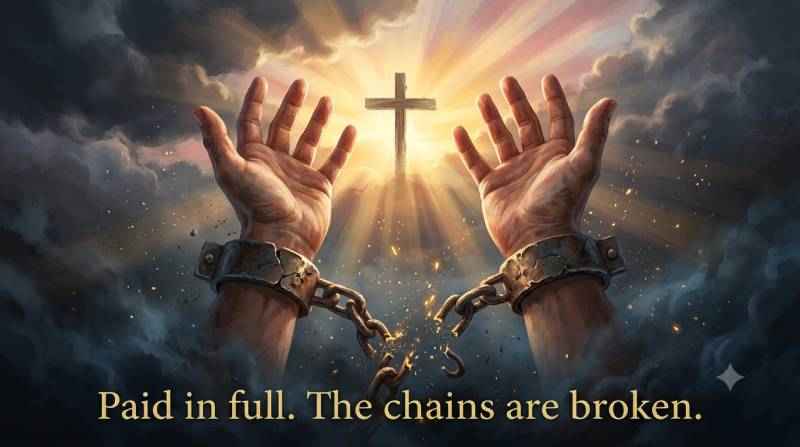
Paul pictures it almost like Meera’s envelope. God has forgiven us, he says, “by canceling the record of debt that stood against us… nailing it to the cross” (Colossians 2:13-14). That long, shameful list of everything we owe isn’t waiting on God’s desk to be collected. It was taken and nailed to a cross. Marked paid.
Who paid it? Jesus. He lived the life we couldn’t, died the death we deserved, and rose again on the third day, so that death would not have the last word. And here’s the part that should stop us: “God shows his love for us in that while we were still sinners, Christ died for us” (Romans 5:8).
While we were still sinners. Not after we apologized. Not after we got our act together. Meera’s brother didn’t wait for her to call first. The payment was made while she was still angry, still silent, still unaware. That’s what love looks like when it moves first.
And notice what it cost him. The car. For Jesus, the cost was his life. Nothing about this was cheap. It just wasn’t charged to us.
How to Be Saved: A Gift That Still Has to Be Opened
Here’s what keeps nagging me. Imagine Meera had never driven to the bank. The debt would still be paid, and she’d still be lying awake at 11 p.m., staring at the envelope, living as though nothing had changed.
Jesus describes the same kind of waiting: “Behold, I stand at the door and knock. If anyone hears my voice and opens the door, I will come in” (Revelation 3:20). He knocks. He doesn’t break the door down. The gift is finished, and it waits for a response.
And the response is simpler than most of us expect. In fact, the Bible’s answer to how to be saved fits in a single sentence: “If you confess with your mouth that Jesus is Lord and believe in your heart that God raised him from the dead, you will be saved” (Romans 10:9).
Two words matter there: Savior and Lord. He’s the one who paid what you couldn’t, and the one you now follow, trusting his way over your own. The Bible calls turning toward him repentance, which simply means changing direction and walking his way. It isn’t earning. It’s receiving, and then learning to live like someone who’s been set free.
How to Be Saved: What This Might Look Like for You
Maybe you’re thinking, I’ve never opened my envelope. Or I knew this once and drifted. Or I’m not sure I believe it, but I can’t stop thinking about it. Wherever you are, here’s how to be saved in small, honest steps you can take today.
- Be honest with God tonight. No fancy words. “God, I haven’t done this right, and I need you” is a real prayer. He isn’t looking for a performance.
- Name what you’ve been doing to pay it yourself. Guilt? Perfectionism? Trying to be good enough? Picture yourself setting it on the counter and walking away from it. That debt isn’t yours to carry anymore.
- Read the story for yourself. Open the Gospel of John, the fourth book of the New Testament, and read a chapter a day. Ask one question as you go: Who is this man, and why do people keep falling at his feet?
- Tell one person. If you decide to follow Jesus, tell a friend, a pastor, or a believer you trust. Faith was never meant to be carried alone.
- Find a community. Look for a local church where the Bible is taught, and people are honest about their struggles. You’ll grow faster alongside others.
How to Be Saved: A Simple Prayer
Words don’t save you. Trusting Christ does. But a prayer is a way of telling him so, and it’s a simple, honest answer to how to be saved. You’re welcome to use these words or your own:
Lord Jesus, I come to you just as I am. I know I’ve gone my own way, and I can’t fix it myself. I believe you died for my sins and rose again. Thank you for paying what I could never pay. Forgive me. Come into my life as my Savior and my Lord, and help me follow you from today on. Amen.
If you prayed that and meant it, Jesus says you have “passed from death to life” (John 5:24). Welcome to the family. Tell someone today, and open the Gospel of John tomorrow.
One Last Thing
Now you know how to be saved. Somewhere, a name is on the screen. A price has already been paid. And an envelope is sitting on a desk, waiting to be opened.
What will you do with yours?
Gospel tract stories from Bibilium: short, heartfelt reads that explain the good news of Jesus and show you how to respond with a simple prayer.